
The short answer
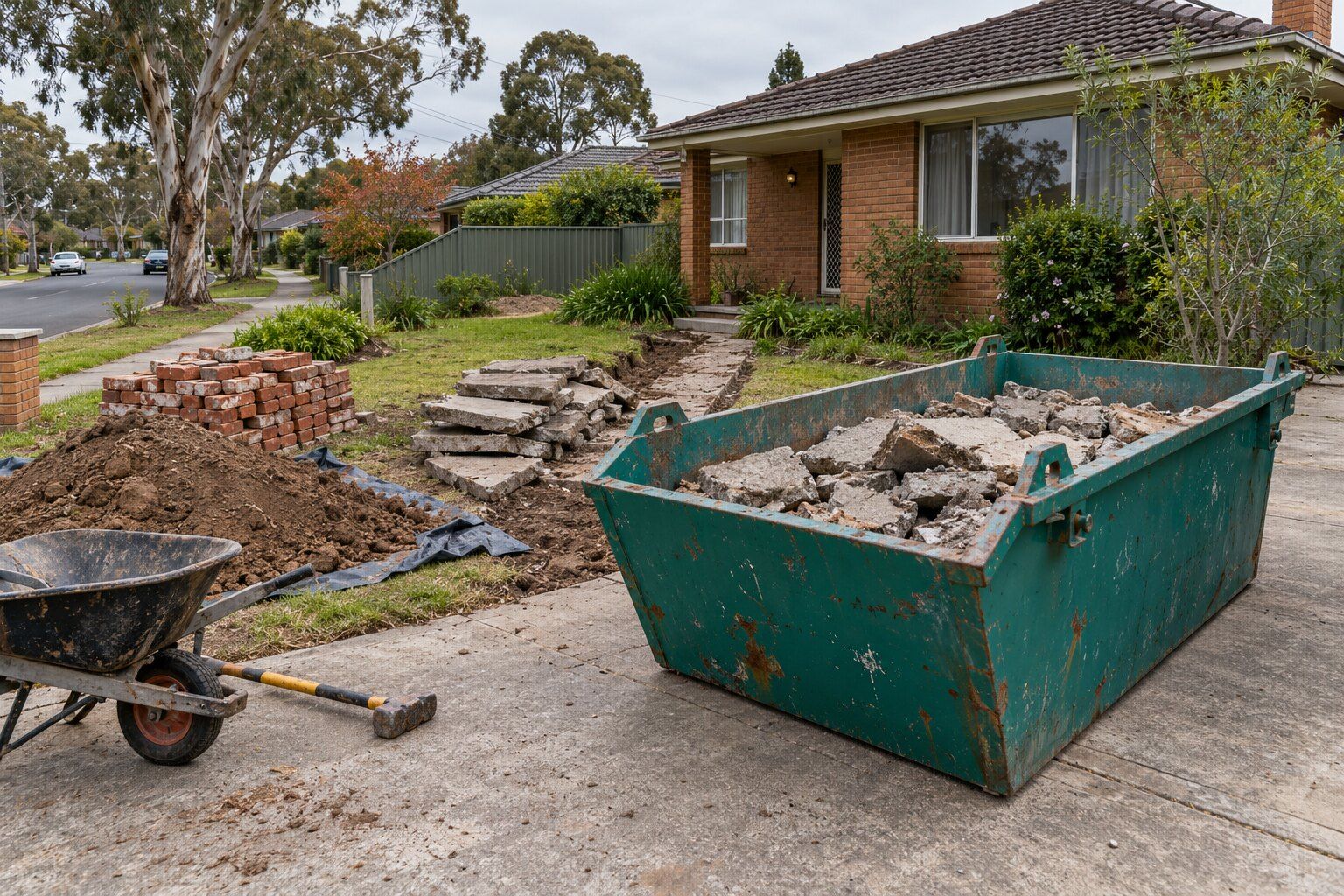
Council hard rubbish won’t take concrete, bricks or soil anywhere in the east. For a small amount, a transfer station takes clean concrete and bricks by the tonne or cubic metre; Whitehorse doesn’t take soil. For a bigger job, a skip of one material (all concrete, all bricks or all clean soil) is priced lower than a mixed load. Soil that might be contaminated can only go to a licensed landfill.
Why hard rubbish and your bins won’t take it
All six councils in the east leave building rubble out of hard rubbish. Knox names “soil, bricks, concrete, sand, rubble, and roof or ceramic tiles”; Whitehorse names “cement, concrete, sand and soil”; Manningham, Monash, Maroondah and Yarra Ranges exclude building and renovation material in the same way. Your council’s rules are in its hard rubbish guide.
That leaves three routes: a tip run, a skip, or (for clean soil only) someone who genuinely wants it.
Work out the weight before you load a trailer
EPA Victoria’s conversion figures for stockpiled waste put broken concrete at 1.5 tonnes per cubic metre and soil at 1.8 tonnes. By our arithmetic, that makes one wheelbarrow load (about 0.1 m³) of soil roughly 180 kg, and a cubic metre of soil heavier than many small box trailers are rated to carry. Check the trailer’s compliance plate before you load it, and expect several trips for anything bigger than a garden bed.
The soil and concrete weight calculator turns your measurements (a slab, a path or a hole) into tonnes, using the same EPA figures.
Tip prices for concrete, bricks and soil
Transfer stations charge heavy waste by weight or volume, and clean, sorted loads cost far less than mixed rubbish. At Whitehorse, bricks and concrete are $122.00 per tonne against $407.00 per tonne for rubbish. Each station’s own prices, not a range:
Concrete, bricks and soil at transfer stations in the east
| Load | Published price | Who publishes it |
|---|---|---|
| Bricks, concrete and ceramics | $122.00 per tonne, minimum $60.00 | Whitehorse Recycling and Waste Centre, Vermont South |
| Concrete and brick, Monash resident | $146.00 per m³ | Monash Recycling and Waste Centre, Notting Hill |
| Clean fill: concrete, tiles, bricks and heavy inert (up to a tandem trailer) | $406.50 per tonne | Knox Transfer Station, Wantirna South |
| Clean fill: concrete, tiles, bricks and heavy inert (residential) | $428.50 per tonne | Coldstream Transfer Station (Yarra Ranges Recycling Services) |
| Soil, less than 1 m³, Monash resident | $452.00 per m³ | Monash Recycling and Waste Centre, Notting Hill |
| Soil, 1 m³ and more, Monash resident | $565.10 per m³ | Monash Recycling and Waste Centre, Notting Hill |
Gate prices from 1 July 2026, as each station publishes them. Knox, Whitehorse and Coldstream include GST; Monash doesn’t say, and its prices are for residents and ratepayers with proof of address. Whitehorse doesn’t take soil, and Monash asks you to call before bringing it. Knox and Coldstream were checked on 1 October 2026; Whitehorse and Monash on 12 October 2026.
Opening hours and addresses are in the guide to tips and transfer stations. Montrose Transfer Station also takes construction and demolition waste; call it for a price.
Clean fill or mixed: sort it before it goes
Whether it’s a tip or a skip, the price depends on keeping materials apart. “Clean fill” means one material and nothing else: all concrete, all bricks, or all soil with no grass, roots, rubbish or timber through it. A mixed heavy load (rubble, tiles and soil together, or with some general waste) is charged at a higher rate, and some companies won’t take mixed soil at all: Suburban Skips in Kilsyth, for one, says “No mixed Dirt”.
- Break slabs into pieces you can lift, and knock the dirt off concrete and bricks.
- Strip turf and roots off soil first: they belong with green waste.
- Keep reinforcing mesh and other steel apart if you can: the Whitehorse and Monash centres take scrap metal free.
Published single-material skip prices
| Skip size | 100% concrete, dry dirt, brick or green, Yarra Valley Skip Bins | Clean fill (100% soil, bricks or concrete), ASAP Bin Hire |
|---|---|---|
| 2 m³ | $415 | $280 |
| 3 m³ | $465 | $370 |
| 4 m³ | $495 | $450 |
| 6 m³ | $625 | $600 |
| 8 m³ | $735 | $750 |
Single-material skips: one material only, filled level with the top edge. Yarra Valley Skip Bins’ price applies to 100% concrete, 100% dry dirt, 100% brick or rubble, or 100% green waste or timber, and it doesn’t offer these loads in 10 m³ or larger skips; mixed heavy loads cost more and carry a weight limit (its “heavy” price for 4 m³ is $725, up to 1.3 t). ASAP Bin Hire’s clean fill means 100% clean soil, 100% bricks or 100% concrete, with no 10 m³ or larger option published. GST not stated by either. Checked 1 October 2026.
Fill a heavy skip level with the top edge and no higher. Because of the weight, heavy jobs use 2 to 4 m³ skips, and Yarra Valley Skip Bins doesn’t offer single-material loads in its 10 m³ or larger skips.
Giving soil away, and EPA’s warning about “free” fill
Clean soil is often wanted for levelling or garden beds, and giving it away can cost nothing. But EPA Victoria is clear that the responsibility goes with it. In a December 2025 release it warned that “If you accept soil that has not been independently tested, you risk being held responsible”, that receivers should “Ask for proof that the soil is clean, including laboratory results”, and that “You cannot pass your responsibility off to anyone else”. Two contractors were fined $4,070 and $2,035 over soil dumped on the Mornington Peninsula.
EPA calls soil with extremely low levels of contamination “fill material”, and says sites without an EPA permission can only accept fill “with all waste removed so far as reasonably practicable”. Soil that’s contaminated falls into EPA’s categories A to D, or soil containing asbestos, and “Contaminated soil may only be disposed of at a licensed landfill”.
When to be careful: soil from under an old shed, a former driveway or garage floor, a site with buried rubbish, or anywhere near fibro offcuts. If you aren’t sure it’s clean, don’t give it away or tip it as clean fill. Wollert Landfill, for one, prices contaminated Category C and D soil separately and needs pre-approval.
Common questions
Can I put soil or concrete out for hard rubbish?
No. Knox, Maroondah, Whitehorse, Manningham, Monash and Yarra Ranges all exclude soil, bricks, concrete and building rubble from hard rubbish.
Where is the cheapest place to dump concrete in the east?
Of the published prices, the Whitehorse Recycling and Waste Centre in Vermont South charges $122.00 per tonne for bricks, concrete and ceramics, with a $60.00 minimum, including levy and GST. The load must be clean: mixed rubbish is $407.00 per tonne there.
Which tips take soil?
Monash takes it from residents and ratepayers ($452.00 per m³ under 1 m³), but asks you to call first; Whitehorse doesn’t take soil at all. Knox and Coldstream price clean fill by the tonne. Check before you load up.
Can I mix soil, concrete and bricks in one skip?
Usually, as a mixed heavy load with a weight limit, but it costs more than a skip of one material, and some companies don’t take mixed soil. If you can keep them apart, two small single-material skips can work out cheaper.
How big a skip do I need for a concrete path?
Work from the weight, not the volume. By EPA Victoria’s figure, a cubic metre of broken concrete weighs about 1.5 tonnes, so even a short path fills a small skip’s weight limit quickly. The weight calculator works it out from the length, width and thickness.
Where this information comes from
The rules and prices on this page come from these published pages, checked on 12 October 2026.
- Knox City Council: hard rubbish collection · Council page on booked collections and what they exclude
- Whitehorse City Council: hard waste · Council page, including its advice for unit and apartment blocks
- Whitehorse Recycling and Waste Centre: items accepted at a charge · Council fees 1 July 2026 to 30 June 2027, including levy and GST
- City of Monash: Recycling and Waste Centre accepted items and fees · Council fees, 1 July 2026 to 30 June 2027
- Knox Transfer Station: gate prices · Transfer station gate prices as of 1 July 2026, GST included
- Yarra Ranges Recycling Services: Coldstream gate prices · Transfer station gate prices as of 1 July 2026, GST included
- Montrose Transfer Station: fees and hours · Operator fees as of 1 July 2026, GST and landfill levy included
- EPA Victoria: Waste Mass Balance Guideline (Publication 2040), Table 3 · State regulator guideline, January 2022; conversion factors for commonly stockpiled waste, tonnes per m³
- EPA Victoria: free soil too good to be true? It just might be · State regulator media release, 23 December 2025
- EPA Victoria: manage waste soil · State regulator guidance on fill material and contaminated soil categories, updated 19 February 2026
- Heidelberg Materials: Wollert Landfill · Landfill operator’s page: hours, asbestos rules and prices, GST included, no price date shown
- Yarra Valley Skip Bins: skip bin hire prices · Skip hire business, Dixons Creek (Yarra Ranges); price table by size, waste and weight limit, no visible date, GST not stated
- ASAP Bin Hire: Bayswater skip bins · Skip hire business, Kilsyth; main “Our skip bins” table (the page also shows a second, different price guide), GST not stated
- Whitehorse City Council: items accepted free · Council list of free items at its centre
- Suburban Skips: prices · Skip hire business, Kilsyth; published sizes, prices and waste rules