
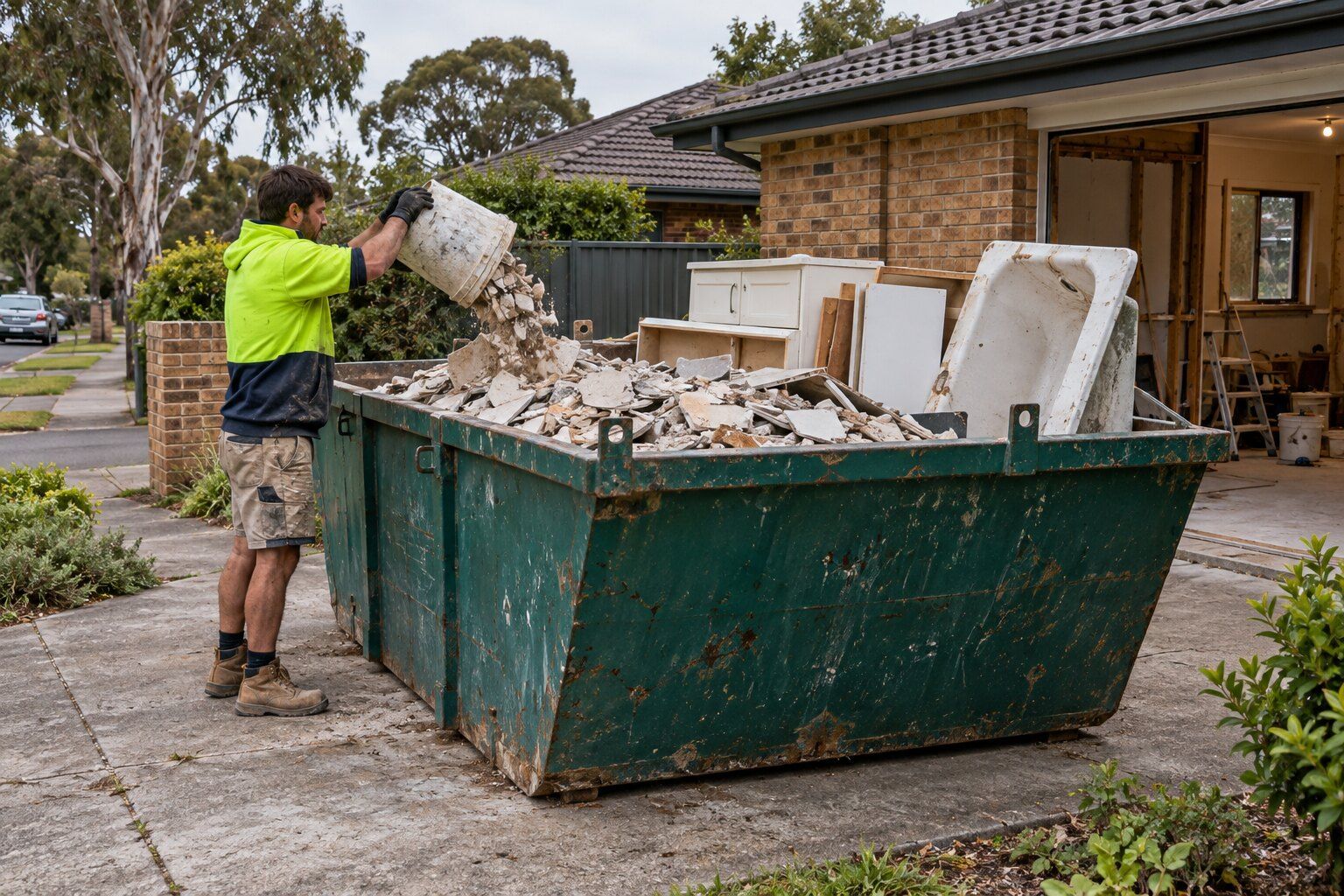
The short answer
For most bathroom renovations, a 3 or 4 m³ skip: the tiles and their bed weigh more than they look, and a fully tiled bathroom can pass a 3 m³ skip’s weight limit before it fills it. A kitchen is the opposite: cabinets and benchtops are bulky but light, so a 4 to 6 m³ skip usually suits, more if walls are coming out. Doing both, or taking out plaster walls too, means a 6 or 8 m³ skip or two smaller ones. That’s our rule of thumb; the worked calculations below show why.
Two limits: space and weight
Every skip has a volume, the cubic metres in its name, and a weight limit set by the skip company. Light waste like cabinets, timber and packaging fills the space first. Heavy waste like tiles, render, bricks and concrete reaches the weight limit first, often when the skip looks half empty.
Yarra Valley Skip Bins publishes its limits for heavy mixed loads, the kind renovation waste is:
Heavy mixed-load weight limits by skip size
| Skip size | Heavy mixed load limit | Light mixed load limit |
|---|---|---|
| 2 m³ | 0.9 t | 0.6 t |
| 3 m³ | 1.0 t | 0.8 t |
| 4 m³ | 1.3 t | 1.0 t |
| 6 m³ | 1.5 t | 1.2 t |
| 8 m³ | 1.8 t | 1.5 t |
| 10 m³ | 2.0 t | 1.6 t |
Yarra Valley Skip Bins (Dixons Creek), as published on its price page, checked 12 October 2026. Other companies set their own limits, and some don’t publish them: ask before you book.
A bathroom: the tiles decide it
Take a 5 m² bathroom, tiled floor to ceiling, with a bath, vanity, toilet and shower screen coming out. By our arithmetic (the same working as our calculator), the tiles and their bed weigh about 1.1 tonnes and, broken up, take about 0.8 m³. The fixtures add about 1.3 m³ but little weight. That’s about 2.1 m³ in all.
By volume, a 3 m³ skip holds it. By weight, it doesn’t: 1.1 tonnes is over a 3 m³ skip’s 1.0 t heavy limit, so the right skip is a 4 m³ (1.3 t). The same bathroom tiled only to 1.2 m comes to about 0.75 tonnes and 1.8 m³, which fits a 2 m³ skip, just. A small bathroom that’s mostly tiles is a job for a mini skip; a big one needs the weight checked.
- Break the bath and vanity down if you can, or stand the bath on its end in a corner.
- Load tiles and rubble first and spread them along the floor, then the fixtures on top.
- Fill level with the top edge: an overfilled skip can’t be moved, and M Tucker & Sons, for one, charges a $110.00 return fee.
A kitchen: bulky but light
Take a kitchen with 4 m of base cabinets and benchtop, 3 m of wall cabinets, a tall pantry unit and 2 m² of tiled splashback. Taken out as whole units, by our arithmetic that’s about 3.7 m³, with only about 70 kg of tiles. A 4 m³ skip holds it as it comes; knocking the carcasses flat and stacking the doors saves room.
Kitchens grow quickly. A stone benchtop is heavy, plaster walls coming down add bulk, and the old appliances can’t go in at all (see below). If the walls or floor are coming out too, a 6 m³ skip is the safer size.
Before anything goes in: asbestos and what stays out
Bathrooms are where older homes in the east most often hide asbestos: the Better Health Channel names bathroom wall linings and the cement underlay beneath tiles among the usual places in homes built before 1990, along with vinyl floor tiles. If your bathroom could be that old, get the linings checked before you start. Asbestos can never go in a skip; see asbestos disposal.
The rest of what can’t go in a renovation skip:
- Old dishwashers, rangehoods, ovens and anything with a plug or battery: e-waste, banned from Victorian landfill since 2019.
- Paint, solvents, adhesives with liquid in them, and gas bottles.
- Soil from under a floor, unless the skip is booked for it.
Everything else (tiles, render, plasterboard, timber, cabinets, packaging) is builders and renovation waste. EPA Victoria says most construction waste is industrial waste that must go to a place authorised to receive it, and that whoever hires the skip should be able to get a docket showing where it went. Ask for one.
Where it goes on a renovation site
On your driveway, a skip needs no permit. On the road it needs a council permit that only the skip company can apply for, and each council in the east sets its own fee and time limit: see skip bin permits. Townhouse driveways and steep hills blocks are where a 2 or 3 m³ mini skip earns its keep, even for a job that needs two of them.
For your own numbers, the skip bin size calculator has bathroom and kitchen modes that work out both the volume and the weight.
Common questions
What size skip do I need for a bathroom renovation?
Usually a 3 or 4 m³ skip. In our worked calculation, a 5 m² bathroom tiled floor to ceiling comes to about 2.1 m³ and 1.1 tonnes, which is over a 3 m³ skip’s 1.0 t heavy limit, so a 4 m³ skip (1.3 t) is the right size. A bathroom tiled only halfway can fit a 2 m³ mini skip.
What size skip do I need for a kitchen renovation?
Usually 4 to 6 m³. A typical kitchen’s cabinets and benchtop take about 3.7 m³ as whole units but weigh little. If walls, flooring or a stone benchtop are coming out too, go up a size.
Can I put plasterboard in a skip?
Yes, in a builders or mixed skip, as long as it isn’t asbestos sheet. EPA Victoria’s figure for stockpiled plasterboard is 0.22 tonnes per cubic metre, so it fills the space long before the weight limit. Council hard rubbish won’t take it.
What happens if the skip is over the weight limit?
You pay more. Yarra Valley Skip Bins says its bin price increases when the weight limit is reached at disposal; M Tucker & Sons charges $40.00 per 100 kg over. See our guide to skip bin weight limits.
Should I get one big skip or two small ones?
For heavy waste, two small ones are often better: each carries its own weight limit, and they fit where a big skip won’t. For light, bulky waste, one larger skip usually costs less than two small ones.
Where this information comes from
The rules and prices on this page come from these published pages, checked on 12 October 2026.
- Yarra Valley Skip Bins: skip bin hire prices · Skip hire business, Dixons Creek (Yarra Ranges); price table by size, waste and weight limit, no visible date, GST not stated
- M Tucker & Sons: skip bins Ringwood · Skip hire business, Mount Evelyn; published hire terms and extra charges (no price table), GST included
- EPA Victoria: Waste Mass Balance Guideline (Publication 2040), Table 3 · State regulator guideline, January 2022; conversion factors for commonly stockpiled waste, tonnes per m³
- Holcim Australia: glossary, density of concrete · Concrete manufacturer’s glossary: about 2,400 kg per m³, “a default design value in AS3600”; no page date
- Better Health Channel: asbestos in the home · Victorian Department of Health page, reviewed 15 October 2019
- Victorian Government: e-waste ban · State government page, updated 14 March 2024
- EPA Victoria: home renovation waste · State regulator guidance, updated 17 December 2024
- EPA Victoria: EPA blitz on rogue skip bin operators · State regulator media release, 4 May 2026